
News
Range Hood Switch Selection: A Buyer's Guide to Piano-Chain, Keycap and Direct-Key Options
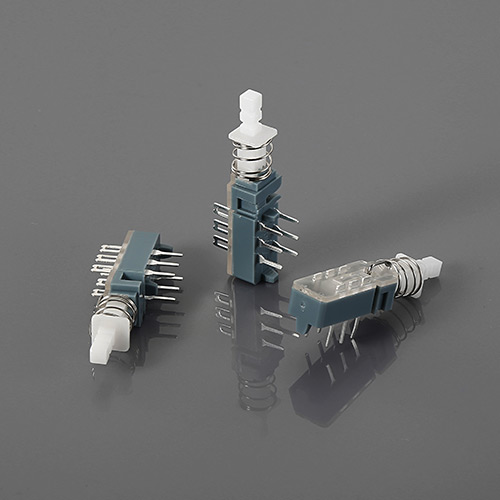
What a range hood switch actually has to do
A range hood switch is the operator interface between the user and the fan and light circuits. In most residential hoods it sits behind a keycap or rocker on the front panel, and the buyer's real task is to match the switch mechanism, the actuator the user touches, and the panel cutout into one assembly that survives kitchen conditions.
Three switch families dominate this part of an appliance control panel:
- Piano-chain switches group several interlinked keys in one housing, so fan speed, light and power can be controlled from a single block. Model KAN-22 is listed in Zijin Electronics' piano-chain switch series for appliance controls and electronic control panels.
- Range-hood switches are the dedicated hood family. Zijin Electronics lists models KDC-A08 and KDC-A08-14 in this category, again for appliance controls and electronic control panels.
- Direct-key switches are individual keys operated directly by the user's finger, usually under a separate keycap. They suit panels where functions are spaced apart or where the panel layout changes between models.
The categories overlap in practice: a piano-chain block is still operated by direct key presses, and a keycap is a cosmetic and tactile part rather than a switching mechanism. The useful distinction for a buyer is how many circuits are switched together, how the user identifies each function, and how the assembly is fixed to the panel.
Start with the control architecture, not the part number
Choosing a switch before the panel architecture is settled usually produces a redesign. Work through these decisions first.
How many functions and circuits
Count the functions the user must operate: typically power, two or three fan speeds, and a light. Then count the electrical circuits behind them. A multi-key piano-chain block can consolidate several functions into one mounting footprint, which simplifies panel assembly. Separate direct-key switches give more freedom in spacing and labeling but multiply the parts and mounting points.
Mechanical or electronic control
Mechanical switches carry the load current directly. Electronic panels use low-current switches as inputs to a control board, which then drives relays or triacs. The two demand different switch ratings and different validation tests. Confirm which architecture the hood uses before comparing switch specifications, because a switch rated for a control-board input is not interchangeable with one that switches a fan motor directly.
Panel space and cutout
Measure the available front-panel area, the panel thickness, and the cutout the switch body requires. Piano-chain blocks need a single elongated opening; individual keys need separate holes with consistent spacing. If the hood is a platform sold under several brands, a layout that tolerates labeling changes is worth more than a marginally cheaper switch.
Selection criteria that separate usable options from risky ones
Once the architecture is fixed, compare candidates on the criteria below. Ask for each as a documented value, not a verbal assurance.
| Criterion | Why it matters for a range hood | Evidence to request |
|---|---|---|
| Contact rating and load type | Fan motors and lamps are inductive or mixed loads; a rating for resistive loads alone does not cover them | Datasheet rating with load type stated, plus the test basis |
| Electrical life | Hoods are switched often over a long service life; cycle count at rated load is the comparable figure | Cycle count at a stated voltage, current and load type |
| Actuation force and travel | Affects perceived quality and whether a keycap stays seated | Force range and travel with tolerance, measured on the supplied sample |
| Terminal type and orientation | Determines wiring harness design and assembly time | Terminal drawing, spacing and recommended wire gauge |
| Mounting and panel thickness range | Snap-in and screw-fixed bodies accept different panel thicknesses | Panel thickness range and retention method |
| Keycap fit | Loose or misaligned caps are a visible defect at retail | Cap-to-switch interface drawing and a fitted sample |
| Flammability and compliance | Kitchen appliances are subject to safety requirements that vary by market | Current certificate or test report naming the exact model and the standard applied |
Two cautions on this table. First, a compliance certificate for one model does not automatically cover a sibling model with a different housing or rating; check that the document names the part you are buying. Second, cycle counts are only comparable when the test voltage, current and load type match. A higher number under a lighter load may be the weaker part.
Piano-chain, direct-key and keycap designs: when each fits
Piano-chain switches
Best where several related functions sit in a row and the panel should read as one control block. The buyer gains fewer mounting points and a consistent key pitch. The trade-off is less layout flexibility: changing the number of functions may mean changing the switch model. Ask how the keys are interlocked, whether adjacent keys can be pressed together, and how the block is retained in the panel.
Direct-key switches
Best where functions are spaced apart, where the panel design differs between hood models, or where a single key must be replaced without disturbing its neighbors. The trade-off is more parts and more assembly steps. Ask for the individual switch's panel thickness range and for the keycap retention method.
Keycaps
A keycap is the interface the user sees and touches; it is not a switch. Selection therefore turns on fit, legend durability, material and color consistency rather than electrical ratings. Request the cap-to-switch interface drawing and confirm that the legend method suits the cleaning chemicals used on kitchen appliances. A cap that fits the sample but not the production switch is a common source of late-stage defects.
Sample and order validation: a practical sequence
Paper specifications rarely settle a switch decision. Use a staged validation so problems surface before tooling or volume orders.
- Drawing review. Obtain dimensioned drawings for the switch and the matching keycap, and check them against your panel model before requesting samples.
- Fit sample. Mount the switch and cap in a panel of the production thickness. Check key travel, wobble, legend alignment and whether the cap can be dislodged by a sideways push.
- Electrical check. Verify contact behavior at the intended load, including any inrush from a fan motor or lamp. Confirm terminal spacing against your harness.
- Environmental and life check. Agree the test conditions with the supplier in writing before testing, so results are comparable with the datasheet.
- Production-lot confirmation. Inspect the first production lot against the approved sample, not against a drawing alone.
Record the approved sample's date and revision. Without that reference, a later dispute about feel or fit has no common baseline.
Supplier questions that reveal real capability
Ask these during evaluation and compare the quality of the answers, not just their presence.
- Which exact models can you supply in the range-hood, piano-chain and direct-key families, and what documentation exists for each?
- Can you provide the rating and life-test basis for the specific model, including load type?
- How do you control keycap color and legend consistency between lots?
- What is your change-notification process if a housing, terminal or material changes?
- Which compliance documents apply to the model quoted, and what is their validity date?
- Can you supply a fitted switch-and-cap sample for panel testing?
Zijin Electronics lists the KAN-22 piano-chain switch and the KDC-A08 and KDC-A08-14 range-hood switches for appliance controls and electronic control panels, with model selection support. Those listings identify the families available; they do not by themselves establish ratings, life figures or certifications, so request the model-specific documents before committing.
Warning signs in a switch quotation
Several patterns should slow a purchase decision:
- Specifications given only as a range across a whole family, with no model-level figures.
- Certificates that do not name the quoted model, or that have expired.
- Life-test claims with no stated load type, voltage or current.
- Keycaps quoted without an interface drawing or a fitted sample.
- No stated process for notifying buyers of material or design changes.
- Unwillingness to supply a sample in the production panel thickness.
None of these is conclusive on its own, but together they shift risk onto your assembly line and your after-sales costs.
Next actions for the buyer
Fix the control architecture and function count, then shortlist one piano-chain block and one direct-key layout for comparison. Request dimensioned drawings and fitted samples for the specific models, including keycaps, and test them in a panel of production thickness. Ask for model-level rating, life and compliance documents, and set a written change-notification requirement before the first order. That sequence turns a switch purchase from a part-number comparison into a verifiable decision.