
News
Appliance Control Switches: Types, Technical Specs and Practical Applications
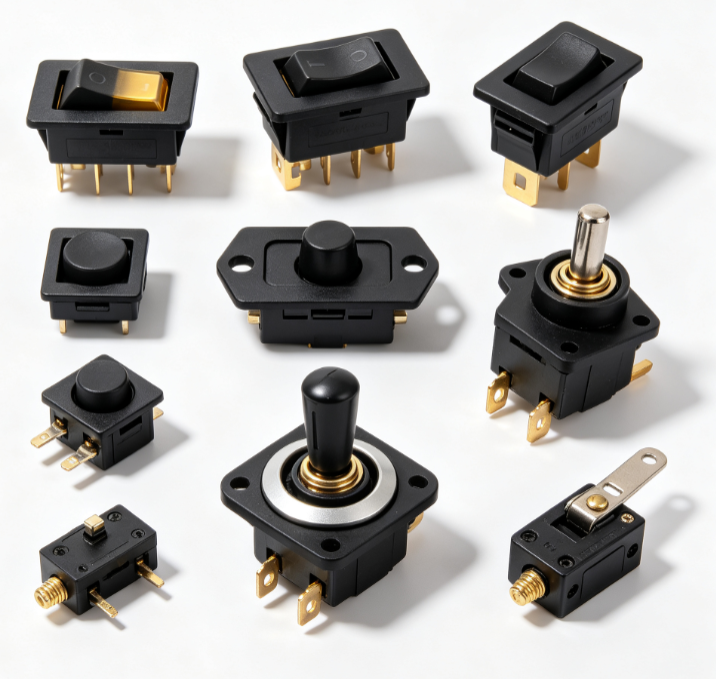
Table of Contents
1. Basic Introduction to Appliance Control Switches
2. Common Types of Appliance Control Switches
3. Technical Performance Comparison Data
4. Core Design and Safety Standards
5. Typical Household and Commercial Applications
6. Industry FAQs for Appliance Control Switches
1. Basic Introduction to Appliance Control Switches
Appliance control switches are core electronic components. They manage power on/off, function switching and speed adjustment for electrical appliances.
These control switches fit low and medium voltage electrical systems. They support daily operation of household and light commercial equipment.
Stable switch performance decide appliance safety and service life. Faulty control parts cause power failure or electric leakage risks.
All qualified appliance control switches follow unified international safety standards. Standardized parameters ensure cross-device compatibility.
2. Common Types of Appliance Control Switches
Different switch structures match different appliance control needs. Each type has fixed working characteristics.
2.1 Rocker Switches
Rocker switches are the most widely used appliance control switches. They adopt seesaw pressing structure for simple on-off control.
They install easily on appliance panels. Common for heaters, water dispensers and small kitchen equipment.
2.2 Tactile Switches
Tactile switches belong to momentary contact components. They trigger signals only when pressed, and reset automatically.
They suit precise function control. Widely used in remote controls, small smart home appliances and control panels.
2.3 Rotary Control Switches
Rotary switches adjust multiple working gears. They support speed, temperature and mode switching for appliances.
Ovens, electric fans and washing machines often use this switch type for multi-level function adjustment.
2.4 Micro Snap Action Switches
Micro switches have sensitive snap action structure. They complete circuit switching with tiny operating force.
They act as safety limit switches. Used in refrigerators, microwave ovens and automatic door appliances.
3. Technical Performance Comparison Data
Electrical rating, service life and stability are key selection indexes. The table below show verified industry test data for mainstream switches.
Switch Type | Rated Voltage | Rated Current | Mechanical Service Life | Core Feature |
Rocker Switch | 125/250 VAC | 16A | 50,000 cycles | High load resistance, simple operation |
Tactile Switch | 12 VDC | 50mA | 100,000 cycles | High precision, small size |
Rotary Switch | 250 VAC | 10A | 6,500 cycles | Multi-gear adjustable control |
Micro Snap Switch | 125 VAC | 1A | 10,000 cycles | Ultra-sensitive trigger response |
Tactile switches have the longest service life in low-current scenarios. It support long-term frequent triggering work.
Rocker switches carry larger current loads. It is the best choice for high-power household appliance main power control.
4. Core Design and Safety Standards
Appliance control switches must meet strict electrical safety regulations. Most products comply with GB/T 15092.1 and CE certification rules.
Qualified switches use brass contact terminals and flame-retardant plastic housing. These materials resist high temperature and prevent electric spark ignition.
Standard insulation resistance of qualified products reach 100 MΩ or higher. It effectively avoid electric leakage risks in humid environments.
Most household appliance control switches adopt IP40 dust-proof grade. It block daily dust and moisture from entering internal structures.
5. Typical Household and Commercial Applications
Appliance control switches cover almost all electric equipment control modules.
Household kitchen appliances use rotary switches and rocker switches. They control oven temperature, fan speed and heater power.
Smart small home appliances rely on tactile switches. They realize precise key signal input and function selection.
Refrigeration and microwave equipment install micro switches. They provide safety limit protection during opening and closing actions.
Light commercial electrical equipment use high-current rocker switches. It ensure stable power control for long-time continuous operation.
6. Industry FAQs for Appliance Control Switches
Q1: Which appliance control switch suits high-power electrical equipment?
A1: Rocker switch is the ideal option. It support 16A large current load, good heat resistance and stable long-term working performance.
Q2: What cause switch failure in daily appliance use?
A2">Frequent overload current, internal dust accumulation and aging contact wear are the main reasons. Humid environment also speed up switch damage.
Q3: What is the standard IP rating for household appliance control switches?
A3">Most civilian switches adopt IP40 rating. It resist dust invasion, but not fit long-term direct water splash environments.
Q4: What is the difference between tactile switch and rotary switch?
A4">Tactile switch do single signal trigger. Rotary switch achieve multi-gear continuous adjustment for temperature and speed functions.